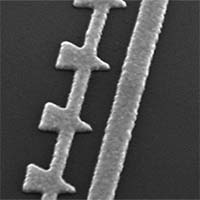
 A team of researchers has succeeded in generating electron pulses with a duration of only a few hundred attoseconds on metallic nanoantennas and used them to measure extremely weak electric fields.

Friday, April 23, 2021
Nanoantennas pave the way to compact petahertz oscilloscopes
A team of researchers has succeeded in generating electron pulses with a duration of only a few hundred attoseconds on metallic nanoantennas and used them to measure extremely weak electric fields.

Watching the evolution of nanostructures in thin films
 Scientists have found a way to turn X-ray fluorescence into an ultra-high position-sensitive probe to measure internal nanostructures in thin films that can be a hundred times finer than a human hair.
Synthesis method expands material possibilities
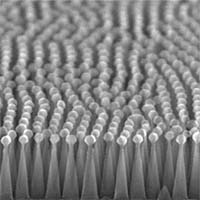 Scientists are making functional inorganic and 'hybrid' materials - those containing both inorganic and organic components - with tunable properties for a wide range of applications, including microelectronics, sensing, and clean energy.
Online talk: What are 2D materials good for?
 The grand finale of CARBONLINEHAGEN 2021 is approaching. Monday, April 26, 16.00 CET will be the last talk this year, and will end with a topic most of us are - or should be - interested in: what 2D materials are good for.
With new optical device, engineers can fine tune the color of light
 A new sort of optical device allows engineers to change the frequencies of individual photons, putting new capabilities in engineers' hands.
Graphene-based 3D motion tracking system could streamline vision for autonomous tech
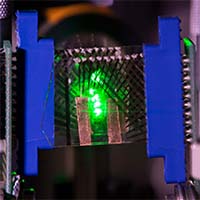 A new real-time, 3D motion tracking system combines transparent light detectors with advanced neural network methods to create a system that could one day replace LiDAR and cameras in autonomous technologies.
Thursday, April 22, 2021
Nanofiltration membranes to treat industrial wastewater from heavy metals
 Researchers have developed innovative membranes for the complete removal of heavy metals from industrial wastewater. The special nanostructure of zinc-modified aluminum oxide made it possible to remove arsenic and lead from water with an efficiency of 87% and 98%, respectively.
Subscribe to:
Posts (Atom)