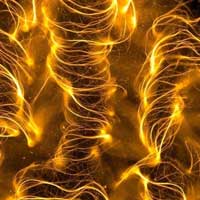
 Researchers report the creation of a 3D active nematic. The material passes through several spatial patterns, from collapsing into a ribbon to wrinkling in 3D.

Thursday, September 24, 2020
The groove of the self-organized active nematic ribbon
Researchers report the creation of a 3D active nematic. The material passes through several spatial patterns, from collapsing into a ribbon to wrinkling in 3D.

Scientists take a 'spin' onto magnetoresistive RAM
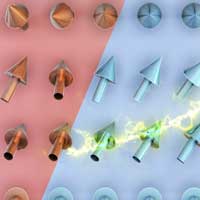 Magnetoresistive random access memory (MRAM) is the forerunning candidate for the next generation digital technology. However, manipulating MRAM efficiently and effectively has been challenging. A revolutionary breakthrough generates spin current to switch the pinned magnetic moments at will.
'Stretching rack' for cells
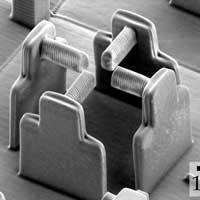 An ingenious device, only a few micrometers in size, enables to study the reaction of individual biological cells to mechanical stress.
The return of the spin echo
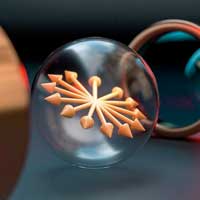 Multiple echoes as a result of a strong link between spins and microwave photons - this effect presents exciting, new opportunities for working with quantum information.
White graphene: high defect tolerance and elasticity unveiled by nanomechanics experts
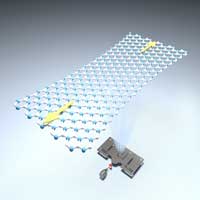 After revealing the realistic strength and stretchability of graphene, researchers have carried forward the success by unveiling the high defect tolerance and elasticity of hexagonal boron nitride (h-BN), another 2D material known as 'white graphene'. This follow-up study will promote future development and applications of strain engineering, piezoelectronics and flexible electronics.
Researchers develop smallest particle sensor in the world
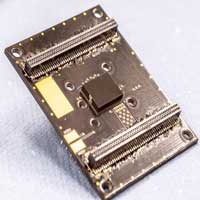 With this innovation, smartphones, smart watches or fitness wristbands can for the first time measure the quality of the ambient air in real time and sound the alarm in the event of increased fine dust values.
New brain cell-like nanodevices work together to identify mutations in viruses
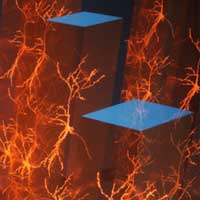 These systems could potentially overcome computational hurdles faced by current digital technologies.
Subscribe to:
Posts (Atom)