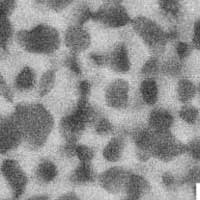
 Researchers have developed nanocomposite ceramics with uniform distribution of two phases, microhardness over 11 GPa, and average grain size of 250 nm. It capable of transmitting over 70% of IR-range with wavelength up to 6,000 nm.

Sunday, December 29, 2019
Scientists develop ceramic materials that are IR-transparent
Researchers have developed nanocomposite ceramics with uniform distribution of two phases, microhardness over 11 GPa, and average grain size of 250 nm. It capable of transmitting over 70% of IR-range with wavelength up to 6,000 nm.

Paving the way for spintronic RAMs: A deeper look into a powerful spin phenomenon
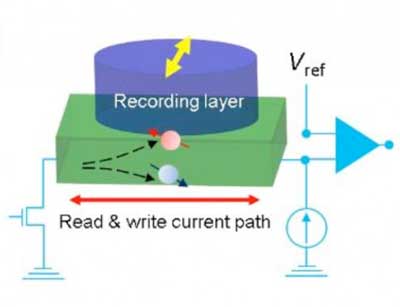 Scientists explore a new material combination that sets the stage for magnetic random access memories, which rely on spin - an intrinsic property of electrons - and could outperform current storage devices. Their breakthrough published in a new study describes a novel strategy to exploit spin-related phenomena in topological materials.
Thursday, December 26, 2019
A fast and inexpensive nanotube device to capture and identify viruses
 Researchers synthesized a gradient of aligned carbon nanotube forest arrays to capture different viruses according to their size and detect them in-situ using Raman spectroscopy. They designed and assembled a portable platform that enriches virus particles from several milliliters of clinical samples in a couple of minutes.
Nanowire device splits and recombines superconducting electron pairs
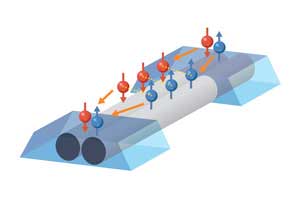 A nanowire device could help explore a form of superconductivity that features exotic particles with potential uses in quantum computing.
Brain-like functions emerging in a metallic nanowire network
 Emerging fluctuation-based functionalities are expected to open a way to novel memory device technology.
Surface acoustic waves in graphene: straintronics with nanoquakes
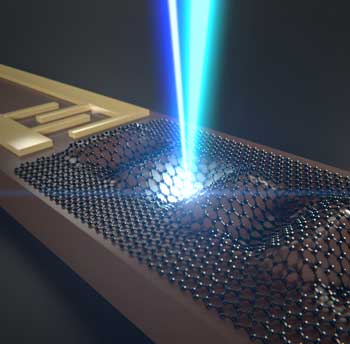 Researchers have shown that the properties of graphene can be locally and dynamically modulated by means of a surface acoustic wave, a kind of earthquake on a chip, generated with an integrated transducer on a piezoelectric substrate holding the graphene sheet.
Monday, December 23, 2019
High-performance anode for all-solid-state Li batteries is made of Si nanoparticles
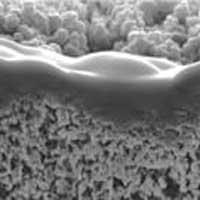 Large volume expansion during charging, the obstacle to using Si anodes in conventional liquid electrolytes, helps a Si anode composed of nanoparticles in solid electrolytes has high-rate discharge capability approaching those of Si films.
Subscribe to:
Posts (Atom)