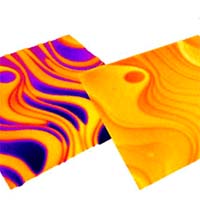
 Elbow mentality in a two-dimensional material: While growing, the material simply pushes interfering steps on the substrate out of the way.

Monday, April 26, 2021
Synthesis of large-area 2D material: Atomic layer pushes surface steps away
Elbow mentality in a two-dimensional material: While growing, the material simply pushes interfering steps on the substrate out of the way.

Why do some alloys become stronger at room temperature?
 Age hardening and creating strong metal mixtures are clearly very important in an industrial context. But very few researchers and people in the industry have cared much about what the clusters actually consist of. They were simply too small to prove.
Novel nanocomposite removes copper and arsenic to avoid livestock industry contamination
 Researchers have develop a nanocomposite to remove Cu(II) and As(III) simultaneously.
Friday, April 23, 2021
Nanoantennas pave the way to compact petahertz oscilloscopes
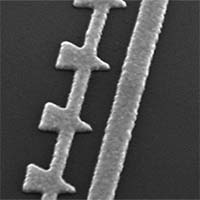 A team of researchers has succeeded in generating electron pulses with a duration of only a few hundred attoseconds on metallic nanoantennas and used them to measure extremely weak electric fields.
Watching the evolution of nanostructures in thin films
 Scientists have found a way to turn X-ray fluorescence into an ultra-high position-sensitive probe to measure internal nanostructures in thin films that can be a hundred times finer than a human hair.
Synthesis method expands material possibilities
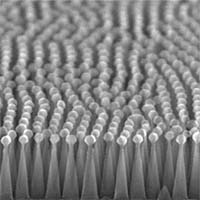 Scientists are making functional inorganic and 'hybrid' materials - those containing both inorganic and organic components - with tunable properties for a wide range of applications, including microelectronics, sensing, and clean energy.
Online talk: What are 2D materials good for?
 The grand finale of CARBONLINEHAGEN 2021 is approaching. Monday, April 26, 16.00 CET will be the last talk this year, and will end with a topic most of us are - or should be - interested in: what 2D materials are good for.
With new optical device, engineers can fine tune the color of light
 A new sort of optical device allows engineers to change the frequencies of individual photons, putting new capabilities in engineers' hands.
Graphene-based 3D motion tracking system could streamline vision for autonomous tech
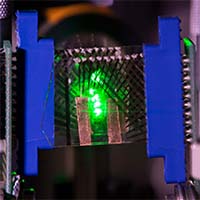 A new real-time, 3D motion tracking system combines transparent light detectors with advanced neural network methods to create a system that could one day replace LiDAR and cameras in autonomous technologies.
Thursday, April 22, 2021
Nanofiltration membranes to treat industrial wastewater from heavy metals
 Researchers have developed innovative membranes for the complete removal of heavy metals from industrial wastewater. The special nanostructure of zinc-modified aluminum oxide made it possible to remove arsenic and lead from water with an efficiency of 87% and 98%, respectively.
Transport phenomena at the nanoscale
 Scientists have exploited the so-called Talbot effect to create the interference pattern with hard X-ray beams at a subnanometer wavelength (0.17 nm).
Breakthrough in materials discovery enables 'twistronics' for bulk systems
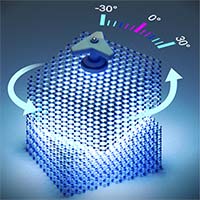 The findings allow manipulation of materials for the first time by stacking films at a twist angle, allowing a new way to control light emitting from materials.
Eliminating dangerous bacteria with nanoparticles
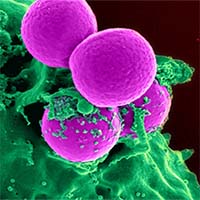 Researchers are developing nanoparticles that can be used to detect and kill multi-resistant pathogens that hide inside our body cells.
Wednesday, April 21, 2021
The sweet taste of success for a supported nickel phosphide nanoalloy catalyst
 Researchers report a nickel phosphide nanoalloy catalyst that cooperates with its support to give high activity for the selective conversion of maltose to maltitol.
Identification of the wettability of graphene layers at the molecular level
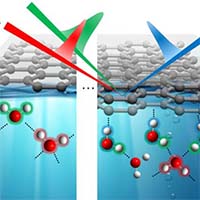 Scientists identify the wettability of graphene layers and improve the understanding of graphene interface properties at molecular levels.
Rapid characterisation of carbon 2D materials
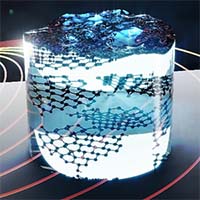 Scientists use Nuclear Magnetic Resonance Proton Relaxation to probe the surface chemistry of nanomaterial dispersions.
Electrifying cement with nanocarbon black
 Researchers have created a cement that conducts electricity and generates heat.
How does Gecko tape work?
 Its name suggests that the tape and the gecko stick in similar ways, but is the underlying physics indeed the same?
Sustainable chemical synthesis with platinum nanoparticles
 A new catalyst allows wood to replace petroleum in hydrocarbon synthesis.
Helpful, engineered 'living' machines in the future?
 New soft, responsive metamaterial holds potential for wide variety of societal benefits.
Subscribe to:
Posts (Atom)