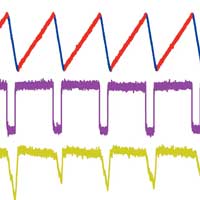
 Researchers demonstrate a newly developed atomic force microscopy approach for imaging biological samples and processes. The method offers higher frame rates and less disturbance of samples.

Tuesday, March 30, 2021
Faster and less-invasive atomic force microscopy for visualizing biomolecular systems
Researchers demonstrate a newly developed atomic force microscopy approach for imaging biological samples and processes. The method offers higher frame rates and less disturbance of samples.

Researchers first to link silicon atoms on surfaces
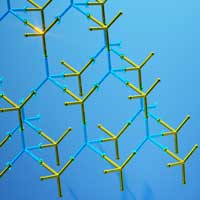
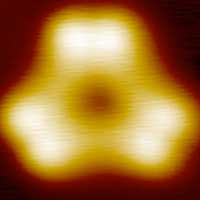 A team consisting of various working groups from the fields of chemistry and physics are now the first to have linked silicon atoms on surfaces. From silicon polymers, the researchers hope for innovative material properties and new, promising candidates for potential applications.
Monday, March 29, 2021
This nanosensor could turn your smartphone into a supersmart gas sensor
 Researchers reported an atomically thin 2D sensor that works at room temperature and thus consumes less power than conventional sensors.
Tires turned into graphene that makes stronger concrete
 Researchers have optimized a process to convert waste from rubber tires into graphene that can, in turn, be used to strengthen concrete.
Standing out: Unusual magnetic transition in perovskite oxide can help boost spintronics
 Scientists examined the perovskite oxide PbFeO3, a compound that has evaded inspection until now, owing to difficulties in synthesizing samples and resolving its crystal structure.
Method offers inexpensive imaging at the scale of virus particles
 Using an ordinary light microscope, researchers can now obtain images with unprecedented accuracy.
Scientists use nanotechnology to detect bone-healing stem cells
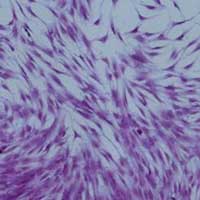 Researchers have developed a new way of using nanomaterials to identify and enrich skeletal stem cells - a discovery which could eventually lead to new treatments for major bone fractures and the repair of lost or damaged bone.
Subscribe to:
Posts (Atom)