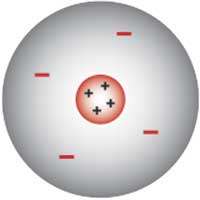
 Simplified model of van der Waals forces will allow previously impossible simulations of how faceted nanoparticles self-assemble into larger structures.

Thursday, November 19, 2020
Predicting forces between oddly shaped nanoparticles
Simplified model of van der Waals forces will allow previously impossible simulations of how faceted nanoparticles self-assemble into larger structures.

A nanomesh pressure sensor that can be attached directly to the skin
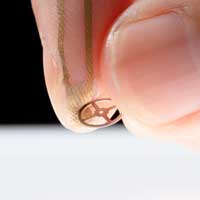 An imperceptible thin-film sensor to record movement and the sense of touch.
Mystery solved: a 'new kind of electrons'
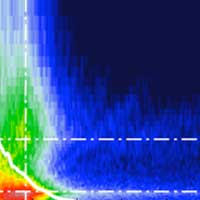 Why do certain materials emit electrons with a very specific energy? This has been a mystery for decades - scientists have now found an answer.
Versatile building blocks make structures with surprising mechanical properties
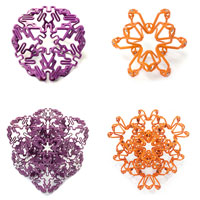 The subunits could be robotically assembled to produce large, complex objects, including cars, robots, or wind turbine blades.
Combining machine learning analysis with 2D material spectroscopy
 Researchers propose a recognition method to distinguish the monolayer continuous film and random defect areas of two-dimensional (2D) semiconductors using machine learning methods with Raman signals.
Improving quantum dot interactions, one layer at a time
 Scientists have found a way to control an interaction between quantum dots that could lead to more efficient solar cells.
Scientists age quantum dots in a test tube
 Researchers have proposed a simple and convenient way to obtain arbitrarily sized quantum dots required for physical experiments via chemical aging.
Subscribe to:
Posts (Atom)