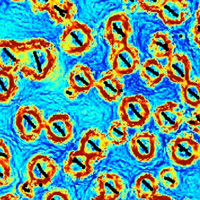
 Active particle suspensions are a class of materials with tunable properties. This new research provides insight into fundamental aspects of the dynamics of such systems that act collectively.

Friday, October 23, 2020
Building materials from spinning particles
Active particle suspensions are a class of materials with tunable properties. This new research provides insight into fundamental aspects of the dynamics of such systems that act collectively.

Topological states caught in the act
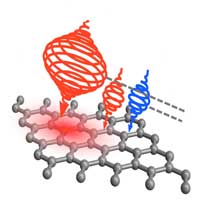 Scientists have shown that short-lived topological states can be tracked with equally short light flashes spiraling like a corkscrew.
Thursday, October 22, 2020
Future VR could employ new ultrahigh-res nanophotonic display
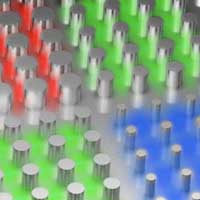 By expanding on existing designs for electrodes of ultra-thin solar panels, researchers have developed a new architecture for OLED - organic light-emitting diode - displays that could enable televisions, smartphones and virtual or augmented reality devices with resolutions of up to 10,000 pixels per inch (PPI).
Do the twist: Making two-dimensional quantum materials using curved surfaces
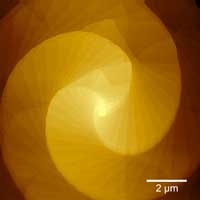 Scientists have discovered a way to control the growth of twisting, microscopic spirals of materials just one atom thick.
A first-of-its-kind nanoparticle catalyst mimics natural processes to break down plastic and produce valuable new products
 Researchers have developed a first-of-its-kind catalyst that is able to process polyolefin plastics such as polyethylene and polypropylene, types of polymers widely used in things like plastic grocery bags, milk jugs, shampoo bottles, toys, and food containers.
Scientists create three-dimensional nanostructures using ion beams
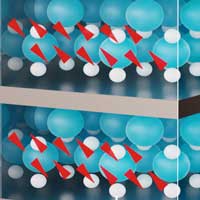 Effects at the interface between magnetic and non-magnetic layers have been exploited for data storage for three decades. This has led to a steady increase in hard drive storage capacity and is one reason why researchers see potential for ushering data processing into a new era.
Scientists are working on cicada-inspired waterproof surfaces
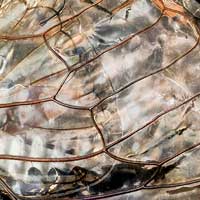 A multidisciplinary group that studies the physical and chemical properties of insect wings has demonstrated the ability to reproduce the nanostructures that help cicada wings repel water and prevent bacteria from establishing on the surface.
Subscribe to:
Posts (Atom)