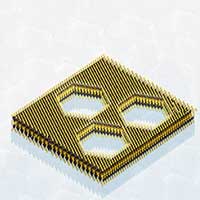
 Researchers present a method for controlling the edges of two-dimensional materials using a 'magic' chemical.

Sunday, October 18, 2020
Creating perfect edges in 2D-materials
Researchers present a method for controlling the edges of two-dimensional materials using a 'magic' chemical.

Researchers design a molecule to implement a quantum error correction code
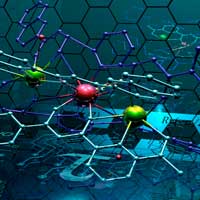 One of the challenges in implementing quantum computing is the protection of quantum states that code the information of errors caused by their interaction with the environment. A solution consists on introducing error protection codes. Scientists designed a molecule that can host an algorithm of this kind. The molecule is formed by erbium and cerium atoms.
Friday, October 16, 2020
Slowing light in an optical cavity with mechanical resonators and mirrors
 Theoretical physicists have shown how a position-dependent mass optomechanical system involving a cavity between two mirrors, one attached to a resonator, can enhance induced transparency and reduce the speed of light.
Zeptoseconds: New world record in short time measurement
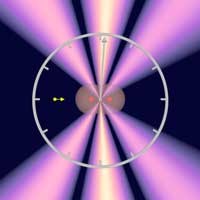 Atomic physicists have for the first time measured how long it takes for a photon to cross a hydrogen molecule: about 247 zeptoseconds for the average bond length of the molecule. This is the shortest timespan that has been successfully measured to date.
Building a microscope with quantum light
 Researchers have built the first infrared based microscope with quantum light. By deliberately entangling the photons, they succeeded in imaging tissue samples with previously invisible bio-features.
Thursday, October 15, 2020
A new ultrafast control scheme of ferromagnet for energy-efficient data storage
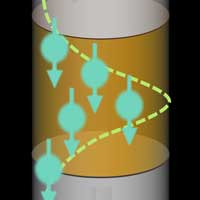 Using a single laser pulse that did not switch the ferrimagnetic layer, researchers demonstrated a much faster and less energy consuming switching of the ferromagnet.
Sprinkled with power: How impurities enhance a thermoelectric material at the atomic level
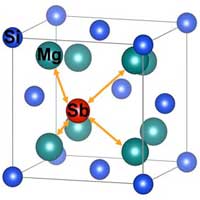 Scientists elucidate how antimony impurities improve the performance of magnesium silicide, a promising material for converting waste heat into electricity.
Subscribe to:
Posts (Atom)