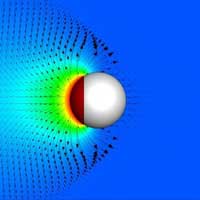
 Scientists have applied the lessons of the water strider and the soapy toothpick to develop an understanding of chemical manipulation of surface tension. Their vehicle? Tiny surfing robots.

Friday, October 9, 2020
What tiny surfing robots teach us about surface tension
Scientists have applied the lessons of the water strider and the soapy toothpick to develop an understanding of chemical manipulation of surface tension. Their vehicle? Tiny surfing robots.

Mind and space bending physics on a convenient chip
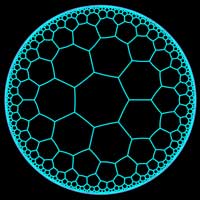 Scientists present new mathematical tools to better understand simulations of hyperbolic spaces. Their new toolbox includes what they call a 'dictionary between discrete and continuous geometry' to help researchers translate experimental results into a more useful form. With these tools, researchers can better explore the topsy-turvy world of hyperbolic space.
Thursday, October 8, 2020
A cost-efficient, single-atom electrocatalyst for hydrogen production
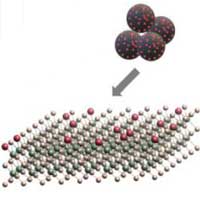 Development of a highly efficient and durable electrocatalyst for water electrolysis that will lead to cost-efficient hydrogen production.
Graphene layer to protect communication systems
 A collaborative research project aims to develop a printable ultrathin layer of carbon to shield sensitive electronics from electromagnetic radiation.
Researchers advance drug delivery systems to treat connective tissue disorders
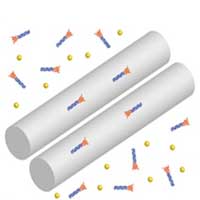 Researchers have devised tiny cargo-carrying systems many times smaller than a human hair, made from molecules called peptides that help provide structure for cells and tissues. The team has reported advances in the nanoparticle design that allow them to control the shape of the nanoparticles to allow them to better bind to tissue in the body and stay in a particular location.
Researchers advance drug delivery systems to treat connective tissue disorders
Researchers have devised tiny cargo-carrying systems many times smaller than a human hair, made from molecules called peptides that help provide structure for cells and tissues. The team has reported advances in the nanoparticle design that allow them to control the shape of the nanoparticles to allow them to better bind to tissue in the body and stay in a particular location.
Programmable photonics
 The chips of the future will include photonics and electronics; they will have a bandwidth, speed and processing and computing abilities that are currently unthinkable; they will make it possible to integrate many other components and their capabilities will increase exponentially compared to electronic chips.
Subscribe to:
Posts (Atom)