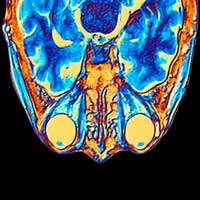
 Researchers have developed a novel noninvasive approach called nano-radiomics that analyzes imaging data to assess changes in the tumor microenvironment that are not detected with conventional imaging methods.

Saturday, July 11, 2020
Nano-radiomics unveils treatment effect on tumor microenvironment
Researchers have developed a novel noninvasive approach called nano-radiomics that analyzes imaging data to assess changes in the tumor microenvironment that are not detected with conventional imaging methods.

Cherned up to the maximum
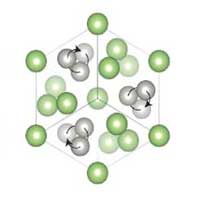 In topological materials, electrons can display behaviour that is fundamentally different from that in 'conventional' matter, and the magnitude of many such 'exotic' phenomena is directly proportional to an entity known as the Chern number. New experiments establish for the first time that the theoretically predicted maximum Chern number can be reached in a real material.
Liquid crystals create easy-to-read, color-changing sensors
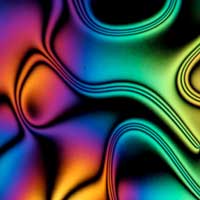 Chameleons are famous for their color-changing abilities. Depending on their body temperature or mood, their nervous system directs skin tissue that contains nanocrystals to expand or contract, changing how the nanocrystals reflect light and turning the reptile's skin a rainbow of colors. Inspired by this, scientists have developed a way to stretch and strain liquid crystals to generate different colors.
Friday, July 10, 2020
'Nanocage' tool untangles (molecular) spaghetti
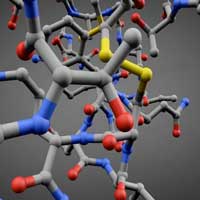 A team of scientists have invented a new tool that can catch and straighten out molecule-sized tangles of polymers - whether made of protein or plastic. This tool, that works a bit like pulling a wad of thread through a needle hole, opens a new way to create custom materials that have never been made before.
Microscopy technique reveals nanoscale detail of coatings as they dry
 Scientists studying in situ drying behavior of thin film coatings visualize interactions that could impact drug delivery technology.
Researchers print nanocoating on next-generation solar cells, allowing them to work in tandem with silicon solar cells to boost efficiencies
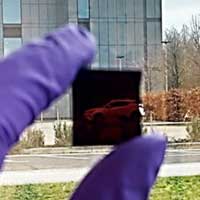 Researchers have developed a method to 'print' a protective coating of copper oxide over the perovskite device. They have shown that only a 3-nanometre thick coating is sufficient to prevent any damage to the perovskite after depositing the transparent top electrode.
Liquid metal synthesis for better piezoelectrics: Atomically-thin tin-monosulfide
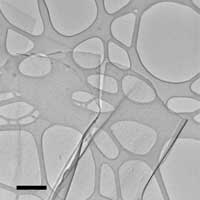 Potential materials for future wearable electronics and other motion-powered, energy-harvesting devices.
Subscribe to:
Posts (Atom)