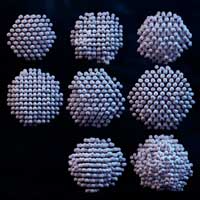
 Liquid phase electron microscopy illuminates 3D atomic structures of platinum nanoparticles, advancing full control of nanoengineering.

Thursday, April 2, 2020
3D reconstructions of individual nanoparticles
Liquid phase electron microscopy illuminates 3D atomic structures of platinum nanoparticles, advancing full control of nanoengineering.

Newly discovered biostability in DNA structures may lead to enhanced design of therapeutics
 Researchers discovered an already existing biostable DNA motif applicable to the design of new drug carriers and diagnostics.
Molding molecular matter
 Scientists used a focused beam of electrons to stitch platinum-silicon molecules into graphene, marking the first deliberate insertion of artificial molecules into a graphene host matrix.
Bacteria on nanowires convert sunlight, carbon dioxide and water to organic building blocks
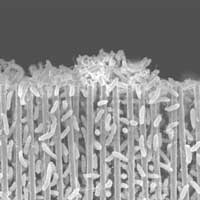 Researchers have developed a hybrid system combining bacteria and nanowires that can capture the energy of sunlight to convert carbon dioxide and water into building blocks for organic molecules.
Wednesday, April 1, 2020
Graphene-based actuator swarm enables programmable deformation
 Graphene-based actuators featuring fast and reversible deformation under various external stimuli are promising for soft robotics and MEMS. However, these bimorph actuators are incapable of complex and programmable 3D deformation, which limits their practical application. Inspired from the collective coupling and coordination of living cells, researchers proposed a moisture-responsive graphene actuator swarm that has programmable shape-changing capability by patterning the SU-8 inert layer underneath.
Artificial intelligence finds 2D materials in the blink of an eye
 Scientists demonstrated a novel artificial intelligence system that can find and label 2D materials in microscope images in the blink of an eye. This work can help shorten the time required for 2D material-based electronics to be ready for consumer devices.
Tuesday, March 31, 2020
Textile-fiber-embedded multiluminescent device for future wearable devices
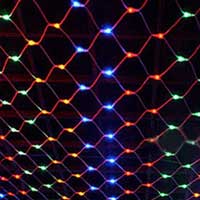 Researchers cross-inserted a new type of electrode made of fibers inside the light emitting layer unlike existing light emitting devices, through which they could develop a new light-emitting technology using an in-plane electric field generated in parallel to the light-emitting layer.
Subscribe to:
Posts (Atom)