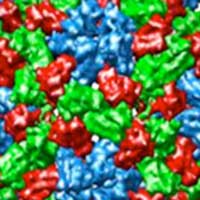
 In nature, viruses use nanocages to protect their genome. Some of these viruses can be disassembled into protein units to remove their genome. These protein units can then be reassembled into nanocages by other templates, the so-called virus-like particles.

Friday, February 28, 2020
A new template for nonspherical viral nanocage
In nature, viruses use nanocages to protect their genome. Some of these viruses can be disassembled into protein units to remove their genome. These protein units can then be reassembled into nanocages by other templates, the so-called virus-like particles.

Stress-relief substrate helps OLED stretch two-dimensionally
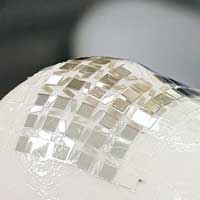 Researchers have created stretchable OLEDs (Organic Light-Emitting Diodes) that are compliant and maintain their performance under high-strain deformation. Their stress-relief substrates have a unique structure and utilize pillar arrays to reduce the stress on the active areas of devices when strain is applied.
New study explains why superconductivity takes place in graphene
 Theoretical physicists take important step in development of high temperature superconductors.
A nanoconcrete for casting under negative temperature conditions
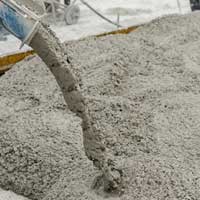 Engineers have developed concrete mixture with nano additives for monolithic construction up to ten stories high. The concrete casting is possible within a very humid climate and negative temperature down to minus 5-degree centigrade.
Thursday, February 27, 2020
Freestanding microwire arrays for transparent solar cells with flexibility
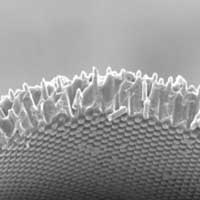 The new solar cell takes a structure in which cylindrical silicon rods are embedded in a flexible and transparent polymer material. As the visible lights passes between polymer materials without silicon rods, it appears entirely transparent to the human eye.
New state-of-the-MOF materials
 Converting crystalline metal-organic frameworks into glass or liquid could give them unique properties and lead to the design of new materials.
Oil separation made easier with 2D material membrane
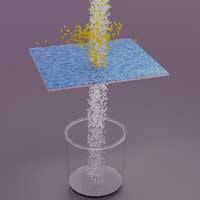 Researchers have made a leap forward in overcoming one of the biggest problems in membrane technology - membrane fouling.
Subscribe to:
Posts (Atom)