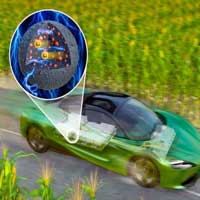
 Newly developed silicon anode materials can increase battery capacity four-fold in comparison to graphite anode materials and enable rapid charging to more than 80% capacity in only five minutes. When applied to batteries for electric vehicles, the new materials are expected to more than double their driving range.

Friday, February 21, 2020
Researchers develop high-capacity EV battery materials that double driving range
Newly developed silicon anode materials can increase battery capacity four-fold in comparison to graphite anode materials and enable rapid charging to more than 80% capacity in only five minutes. When applied to batteries for electric vehicles, the new materials are expected to more than double their driving range.

Black phosphorous tunnel field-effect transistor as an ultra-low power switch
 Researchers have developed a thickness-controlled black phosphorous tunnel field-effect transistor (TFET) that shows 10-times lower switching power consumption as well as 10,000-times lower standby power consumption than conventional complementary metal-oxide-semiconductor (CMOS) transistors.
Thursday, February 20, 2020
Scientists develop new method to isolate atomic sheets and create new materials
 New exfoliation method makes large-area atomically thin layers that can be stacked in any desired order and orientation to generate a whole new class of artificial materials; opens the door to new research and commercialization.
MoS nanoparticles provide a cheaper way to obtain hydrogen
 Researchers propose molybdenum sulfide as a material for the catalysts which is, firstly, more effective than molybdenum, and, secondly, much cheaper since the total amount of expensive metal in catalysts is reduced, and the sulfur is not scarce and very cheap.
New graphene-based metasurface capable of independent amplitude and phase control of light
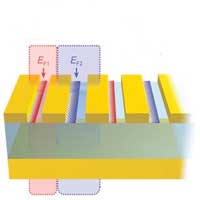 Researchers describe a new strategy of designing metamolecules that incorporates two independently controllable subwavelength meta-atoms. This two-parametric control of the metamolecule secures the complete control of both amplitude and the phase of light.
In acoustic waves, engineers break reciprocity with 'spacetime-varying metamaterials'
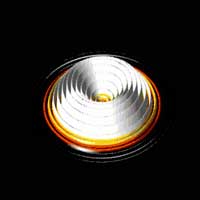 Scientists have experimentally demonstrated that it?s possible to break reciprocity in acoustic waves with material properties that change simultaneously in time and space.
Plant-based relatives of cholesterol could give boost to nanoparticle gene therapy
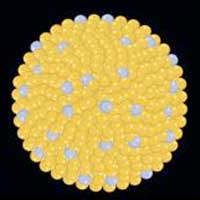 Gene-infused nanoparticles used for combating disease work better when they include plant-based relatives of cholesterol because their shape and structure help the genes get where they need to be inside cells.
Subscribe to:
Posts (Atom)