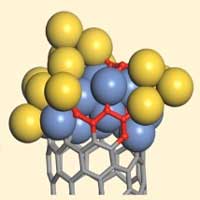
 Revealing a long-term mystery of why certain nanoparticles are more efficient in incorporating carbon atoms and achieving a faster carbon nanotube growth.

Friday, December 20, 2019
Why are alloy metal nanoparticles better than monometallic ones for carbon nanotubes growth?
Revealing a long-term mystery of why certain nanoparticles are more efficient in incorporating carbon atoms and achieving a faster carbon nanotube growth.

Thursday, December 19, 2019
Researchers directly measure 'Cheerios effect' forces for the first time
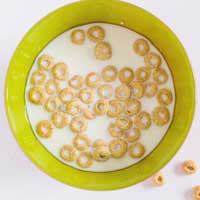 In a finding that could be useful in designing small aquatic robots, researchers have measured the forces that cause small objects to cluster together on the surface of a liquid -- a phenomenon known as the 'Cheerios effect'.
Researchers apply temperature gradients to grow and move liquid crystals
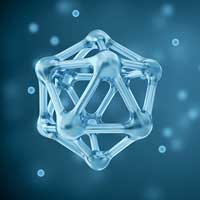 Researchers have discovered that applying a small difference in temperature to a watered-down mixture of a compound called zirconium phosphate initiates its liquid crystallization. As zirconium phosphate particles move toward warmer temperatures, they start aligning themselves with each other and eventually turn into pure liquid crystals.
Playing the angles with dramatic effect
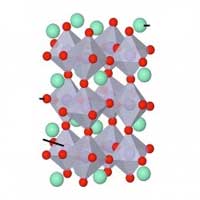 Researchers develop new materials theory relevant to ultrafast electronics, batteries and more.
New quantum material with intrinsically magnetic and topological properties
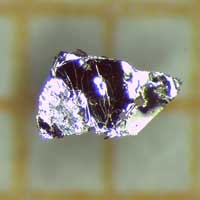 An international consortium of chemists and physicists has discovered a new type of quantum material with intrinsic magnetic and topological properties. Since they manifest without doping or strong external magnetic fields, this material may lead the way to new applications in spintronics, two-dimensional magnetism and quantum transport.
Improved 3D nanoprinting technique to build nanoskyscrapers
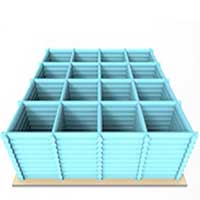 Simply adding 'table salt' helps to build self-stacked nanoarchitectures.
Wednesday, December 18, 2019
Nanopores can identify the amino acids in proteins, the first step to sequencing
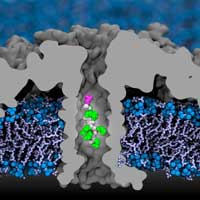 While DNA sequencing is a useful tool for determining what's going on in a cell or a person's body, it only tells part of the story. Protein sequencing could soon give researchers a wider window into a cell's workings. A new study demonstrates that nanopores can be used to identify all 20 amino acids in proteins, a major step toward protein sequencing.
Subscribe to:
Posts (Atom)