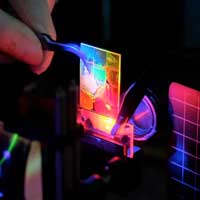
 have developed a way to make colloidal quantum dots produce laser light with the help of an electric field.

Wednesday, November 27, 2019
Quantum dot lasers move a step closer with electric-pumping development
have developed a way to make colloidal quantum dots produce laser light with the help of an electric field.

Seeing the world's smallest universal joints
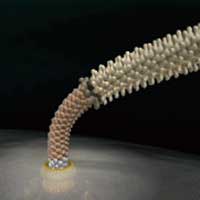 Researchers used electron cryomicroscopy to solve the structure of an essential component of the bacterial flagellum with unprecedented resolution, with important implications for new antibiotics and future nanobots.
All the nanotubes are fit to print
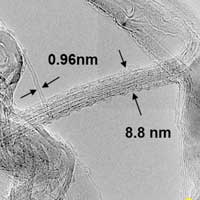 Chemists use newsprint for inexpensive bulk production of carbon nanotubes.
Black silicon can help detect explosives
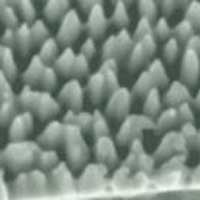 Researchers have developed an ultrasensitive detector based on black silicon. The device is able to detect trace amounts of nitroaromatic compounds and can be applied to identify the majority of explosives or highly toxic pollutants for medical and forensic evaluations.
Scientists find new way to identify, manipulate topological metals for spintronics
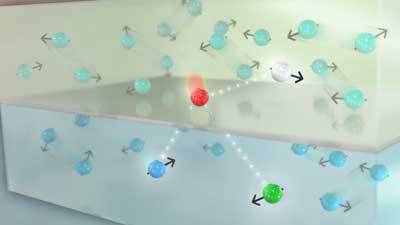 Scientists pioneer technique for working with topological materials.
Atomic-scale manufacturing method could enable ultra-efficient computers
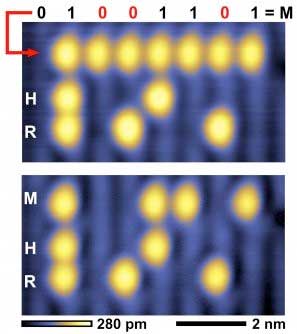 Researchers report a new manufacturing process that could enable ultra-efficient atomic computers that store more data and consume 100 times less power.
New study shows unique magnetic transitions in quasicrystal-like structures
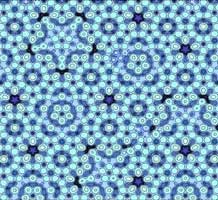 Scientists showed for the first time the presence of unique magnetic transitions in peculiar structures similar to quasicrystals.
Subscribe to:
Posts (Atom)