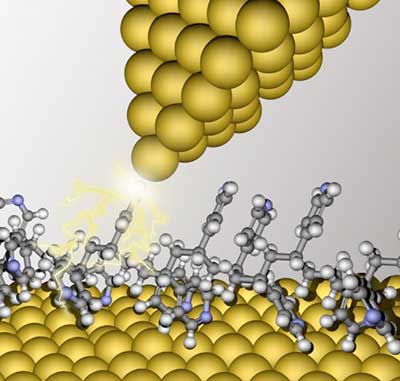
 demonstrate that polymers could play a key role in the fabrication of single-molecule electronic devices, allowing us to push the boundaries of the nanoelectronics revolution.

Monday, May 27, 2019
Polymers may be the key to single-molecule electronic devices
demonstrate that polymers could play a key role in the fabrication of single-molecule electronic devices, allowing us to push the boundaries of the nanoelectronics revolution.

Researchers throw new light on photosynthetic supercomplex structure
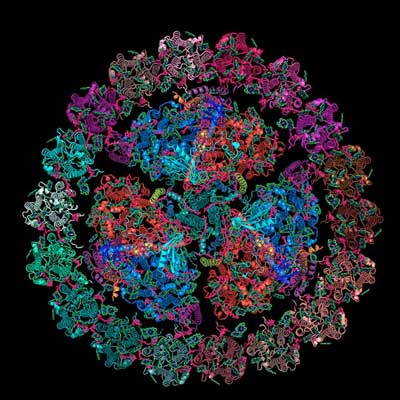 Scientists have taken a significant step closer to unlocking the secrets of photosynthesis, by determining the structure of a very large photosynthetic supercomplex.
For the first time, a gold nanoparticle loaded with CRISPR has been used to edit genes
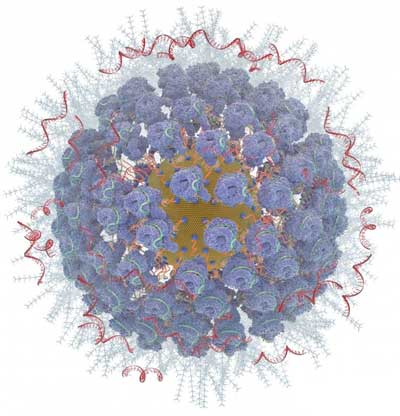 A proof-of-principle study shows that gold nanoparticles loaded with CRISPR and other gene-editing tools safely and effectively edited blood stem cells.
Friday, May 24, 2019
Adding a carbon atom transforms 2-D semiconducting material
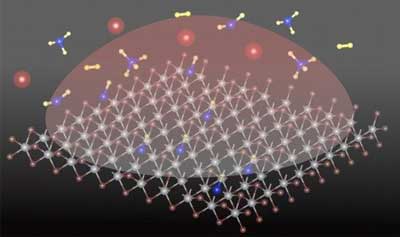 A technique to substitute carbon-hydrogen species into a single atomic layer of the semiconducting material tungsten disulfide, a transition metal dichalcogenide (TMD), dramatically changes the electronic properties of the material.
Rare iron oxide could be combined with 2D materials for electronic, spintronic devices
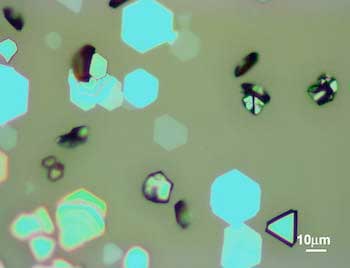 Researchers have simplified the synthesis of a unique, nearly two-dimensional form of iron oxide with strong magnetic properties that is easy to stack atop other 2D materials.
Researchers create soft, flexible materials with enhanced properties
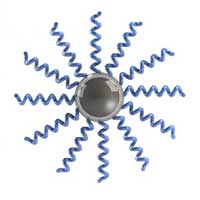 A team of polymer chemists and engineers have developed a new methodology that can be used to create a class of stretchable polymer composites with enhanced electrical and thermal properties.
Mathematically designed graphene has improved electrocatalytic activity
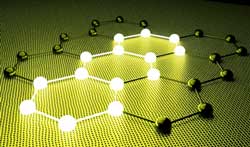 An international research group has improved graphene's ability to catalyse the 'hydrogen evolution reaction', which releases hydrogen as a result of passing an electronic current through water.
Subscribe to:
Posts (Atom)