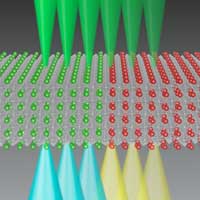
 Scientists have combined two powerful, cutting-edge techniques to uncover the physics behind an exotic phase transition that turns a metal into an insulator. The materials they looked at are rare-earth nickelates, which are of great interest for innovating new approaches in electronics.

Friday, March 19, 2021
Nano-mapping phase transitions in electronic materials
Scientists have combined two powerful, cutting-edge techniques to uncover the physics behind an exotic phase transition that turns a metal into an insulator. The materials they looked at are rare-earth nickelates, which are of great interest for innovating new approaches in electronics.

Thursday, March 18, 2021
Research finds surprising electron interaction in 'magic-angle' graphene
 New research describes a technique that weakens the repulsive force between electrons in 'magic-angle' graphene superconductors, providing physicists with exciting new details about this strange state of matter.
Researchers help keep pace with Moore's Law by exploring a new material class
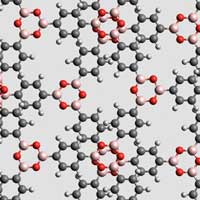 Researchers create a new polymer-based electrical insulation for circuits that could help put more power in smaller spaces.
New perovskite fabrication method for solar cells paves way to large-scale production
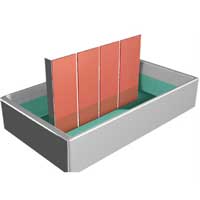 A new, simpler solution process for fabricating stable perovskite solar cells overcomes the key bottleneck to large-scale production and commercialization of this promising renewable-energy technology, which has remained tantalizingly out of reach for more than a decade.
Light it up - using plasmonic metasurfaces in nanophotonics
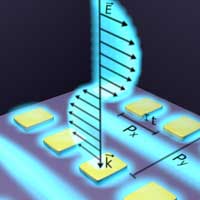 Researchers have debunked the decade-old myth of metals being useless in photonics, with their findings expected to lead to many applications in the field of nanophotonics.
Artificial neuron device could shrink energy use and size of neural network hardware
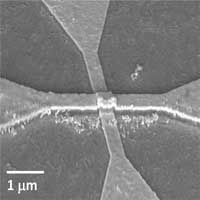 Training neural networks to perform tasks, such as recognizing images or navigating self-driving cars, could one day require less computing power and hardware thanks to a new artificial neuron device. The device can run neural network computations using 100 to 1000 times less energy and area than existing CMOS-based hardware.
Self-assembly of 2D nonclose-packed binary gold nanoparticle arrays with tunable optical properties
 A binary nanoparticle array refers to a periodic structure comprising at least two types of building nanoparticles with component or morphological dissimilarities. Synthetic binary arrays can not only boost structural diversity, but also new optical or thermoelectronic properties synergized from different components.
Subscribe to:
Posts (Atom)