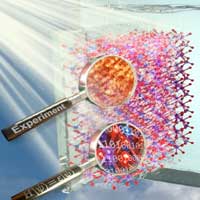
 An electrode material with modified surface atoms generates more electrical current, which drives the sunlight-powered reactions that split water into oxygen and hydrogen - a clean fuel.

Friday, February 19, 2021
Tuning electrode surfaces to optimize solar fuel production
An electrode material with modified surface atoms generates more electrical current, which drives the sunlight-powered reactions that split water into oxygen and hydrogen - a clean fuel.

In new step towards autonomous materials, researchers design patterns in self-propelling liquid crystals
 Researchers have been developing 'active' materials that have the ability to move on their own. Now, they have taken the next step by showing that the movement in one such active material - liquid crystals - can be harnessed and directed.
Thursday, February 18, 2021
Researchers clarify the microscopic origin of dissipation with graphene
 Scientists have provided supporting evidence for the existence of a nonlinear dissipation mechanism in mechanical systems.
Researchers flip the switch to make microsensors super sensitive to biomolecules
 Scientists have found a new way of enhancing the performance of electrochemical micro-sensors. This discovery could lead to the detection of biomolecules, such as dopamine, at lower concentrations than is possible today.
Novel tools for biomedical applications: Bacterial magnetic nanoparticles
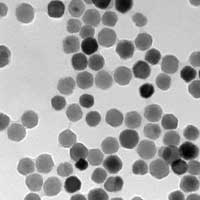 Magnetic nanoparticles biosynthesized by bacteria might soon play an important role in biomedicine and biotechnology. Researchers have now developed and optimised a process for the isolation and purification of these particles from bacterial cells.
Nanofibers for quantum technologies at room temperature
 Atomic vapors are among the most promising platforms for constituting the nodes of future quantum networks. Researchers have now realized a unique interface between an extremely thin optical fiber and an atomic vapor at ambient temperatures.
Researchers develop affordable method for production of transparent solar cells
 Physicists have discovered an affordable method that makes it possible to use transparent materials for solar cells while preserving their efficiency. The new technology is based on the method of doping but without the use of expensive special-purpose equipment.
Subscribe to:
Posts (Atom)