 The newly developed BioAFMviewer software opens the opportunity to use the enormous amount of available high-resolution protein data to better understand experiments. Within an interactive interface with rich functionality, the BioAFMviewer computationally emulates tip-scanning of any biomolecular structure to generate simulated AFM graphics and movies.

Tuesday, December 22, 2020
BioAFMviewer software for simulated atomic force microscopy of biomolecules
The newly developed BioAFMviewer software opens the opportunity to use the enormous amount of available high-resolution protein data to better understand experiments. Within an interactive interface with rich functionality, the BioAFMviewer computationally emulates tip-scanning of any biomolecular structure to generate simulated AFM graphics and movies.

Novel glue is activated by a magnetic field
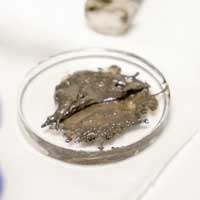 The new 'magnetocuring' adhesive is made by combining a typical commercially available epoxy adhesive with specially tailored magnetic nanoparticles.
Transforming self-assembled architectures into functional materials
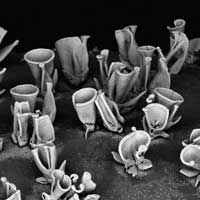 Researchers discovered shape-preserving ion-exchange reactions that open up new routes towards self-assembled materials with various novel, functional properties.
Monday, December 21, 2020
Topological phases in biological systems
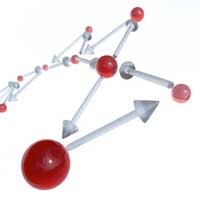 Physicists have shown that topological phases could exist in biology, and in so doing they have identified a link between solid-state physics and biophysics.
Striking gold: Catalysis research at the nanoscale
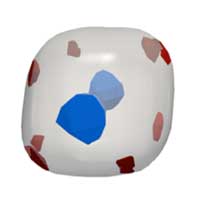 By examining tiny particles of gold with powerful X-ray beams, scientists hope they can learn how to cut down on harmful carbon monoxide emissions from motor vehicles.
Researchers invent method to 'sketch' quantum devices with focused electrons
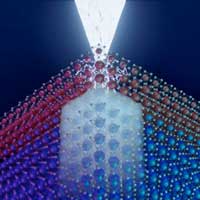 Technique is 10,000 faster than previous methods, and can create active nanostructured gates directly below two-dimensional materials such as graphene.
New nanomaterial a key step toward hydrogen as a stable and clean fuel source
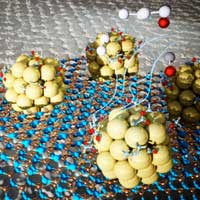 Researchers have designed and synthesized an effective material for speeding up one of the limiting steps in extracting hydrogen from alcohols. The material, a catalyst, is made from tiny clusters of nickel metal anchored on a 2D substrate.
Subscribe to:
Posts (Atom)