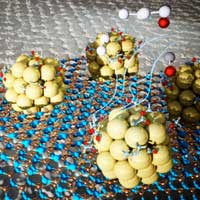
 Researchers have designed and synthesized an effective material for speeding up one of the limiting steps in extracting hydrogen from alcohols. The material, a catalyst, is made from tiny clusters of nickel metal anchored on a 2D substrate.

Monday, December 21, 2020
New nanomaterial a key step toward hydrogen as a stable and clean fuel source
Researchers have designed and synthesized an effective material for speeding up one of the limiting steps in extracting hydrogen from alcohols. The material, a catalyst, is made from tiny clusters of nickel metal anchored on a 2D substrate.

Mapping out a transient atom
 Scientists have published the results of an experiment that could provide a blueprint for the analysis of transitions states in atoms and molecules. This would open up new opportunities to gain insights into important processes such as photocatalysis, elementary steps in photosynthesis and radiation damage.
Skyrmions - the basis for a completely new computer architecture?
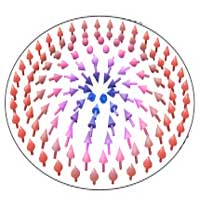 A team of researchers has succeeded for the first time in producing a tunable multilayer system in which two different types of skyrmions - the future bits for '0' and '1' - can exist at room temperature.
Goldilocks and the three quantum dots: This one's just right for peak solar panel performance
 Maximising the efficiency of renewable energy technology is dependent on creating nanoparticles with ideal dimensions and density, new simulations have shown. Scientists have developed a process for calculating the perfect size and density of quantum dots needed to achieve record efficiency in solar panels.
Saturday, December 19, 2020
Seeking answers in ferroelectric patterning
 Why do some ferroelectric materials display bubble-shaped patterning, while others display complex, labyrinthine patterns? A new study finds the answer to the changing patterns in ferroelectric films lies in non-equilibrium dynamics, with topological defects driving subsequent evolution.
Friday, December 18, 2020
Atomic-scale apertures represent a novel regime in physics and materials science
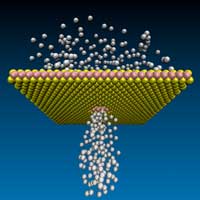 Two new studies demonstrate how to fabricate atomically-thin materials with atom-sized pores, with possible applications ranging from water purification to energy harvesting.
Shifting gears toward chemical machines
 Engineers have utilized a catalytic reaction that causes a two-dimensional, chemically-coated sheet to spontaneously 'morph' into a three-dimensional gear that performs sustained work.
Subscribe to:
Posts (Atom)