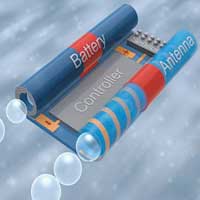
 Researchers report the development of the smallest microelectronic robot in the world, which is driven and controlled by a twin-jet-engine.

Monday, May 4, 2020
The smallest microelectronic robot in the world
Researchers report the development of the smallest microelectronic robot in the world, which is driven and controlled by a twin-jet-engine.

How to put neurons into cages
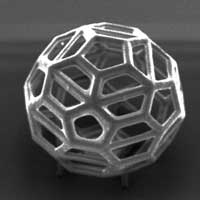 Nerve cells have now been introduced into spherical cage structures using acoustic bioprinting technology, so that multicellular nerve tissue can develop there.
Saturday, May 2, 2020
Red light for stress
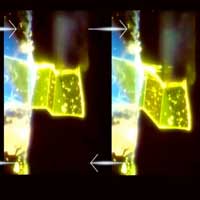 Researchers have created a biphasic luminescent material that changes color when exposed to mechanical stress. This work has many applications in the field of smart materials, which includes sensors for monitoring the strain on objects.
Pressing 'pause' on nature's crystal symmetry
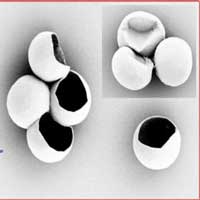 From snowflakes to quartz, nature's crystalline structures form with a reliable, systemic symmetry. Researchers have shown that it's now possible to control how crystals grow - including interrupting the symmetrical growth of flat crystals and inducing them to form hollow crystal spheres.
Nanostimulators boost stem cells for muscle repair
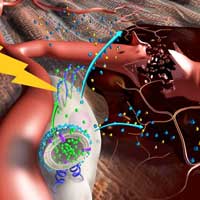 Scientists demonstrated that 'nanostimulators' - nanoparticles seeded with a molecule the body naturally produces to prompt stem cells to heal wounds - can amp up stem cells' regenerative powers in a targeted limb in mice.
Team makes breakthrough in separation science with sub-Angstrom precision
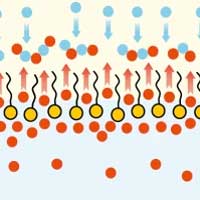 An international research team is the first to successfully separate two ions with very, very small size differences, a major advancement in separation science with widespread potential application.
New study reveals unexpected softness of bilayer graphene
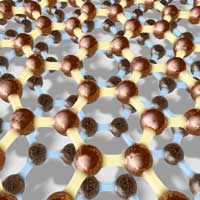 Research has found that bilayer graphene is much softer than multi-layered graphite.
Subscribe to:
Posts (Atom)