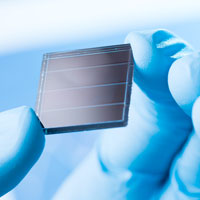
 Researchers have successfully combined graphene with tandem perovskite-silicon solar cells to achieve efficiencies of up to 26.3%. Moreover, they envisioned a new manufacturing method that, thanks to the versatility of graphene, allows to reduce production costs and could lead to the production of large-area solar panels.

Tuesday, March 3, 2020
Graphene, perovskites, and silicon - an ideal tandem for efficient solar cells
Researchers have successfully combined graphene with tandem perovskite-silicon solar cells to achieve efficiencies of up to 26.3%. Moreover, they envisioned a new manufacturing method that, thanks to the versatility of graphene, allows to reduce production costs and could lead to the production of large-area solar panels.

Monday, March 2, 2020
Scientists succeed in measuring electron spin qubit without demolishing it
 Scientists have succeeded in taking repeated measurements of the spin of an electron in a silicon quantum dot, without changing the spin in the process. This type of 'non-demolition' measurement is important for creating quantum computers that are fault tolerant.
Twisted 2D material gives new insights into strongly correlated 1D physics
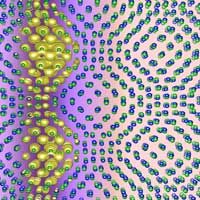 Researchers have revealed that the possibilities created by stacking two sheets of atomically thin material atop each other at a twist are even greater than expected.
Handed light throws electronic curve balls in quantum flatland
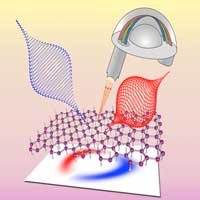 An international team of researchers has demonstrated that the Berry curvature - an important property of quantum materials - can be imaged with chiral light.
Atomic vacancy as quantum bit
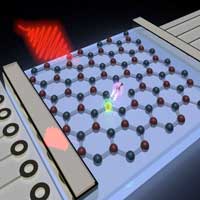 Phycsicists for the first time have experimentally observed spin centers in two-dimensional materials. Such centers can act as quantum bits - even at room temperature.
Ultrafast probing reveals intricate dynamics of quantum coherence
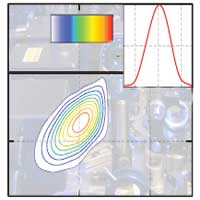 Ultrafast, multidimensional spectroscopy unlocks macroscopic-scale effects of quantum electronic correlations. Researchers found that low-energy and high energy states are correlated in a layered, superconducting material LSCO (lanthanum, strontium, copper, oxygen).
Friday, February 28, 2020
A new template for nonspherical viral nanocage
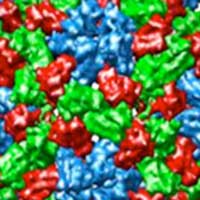 In nature, viruses use nanocages to protect their genome. Some of these viruses can be disassembled into protein units to remove their genome. These protein units can then be reassembled into nanocages by other templates, the so-called virus-like particles.
Subscribe to:
Posts (Atom)