 Researchers use atomically thin materials to manipulate the phase of light without changing its amplitude, at extremely low power loss; could enable applications such as LIDAR, phased arrays, optical switching, and quantum and optical neural networks.

Wednesday, February 26, 2020
Researchers discover new way to control the phase of light using 2D materials
Researchers use atomically thin materials to manipulate the phase of light without changing its amplitude, at extremely low power loss; could enable applications such as LIDAR, phased arrays, optical switching, and quantum and optical neural networks.

Metal-organic frameworks can separate gases despite the presence of water
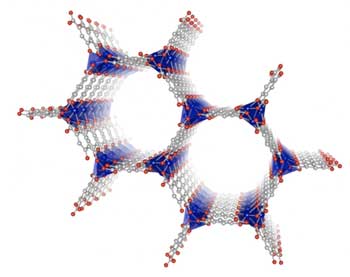 Metal-organic frameworks (MOFs) are promising materials for inexpensive and less energy-intensive gas separation even in the presence of impurities such as water.
MOF co-catalyst allows selectivity of branched aldehydes of up to 90%
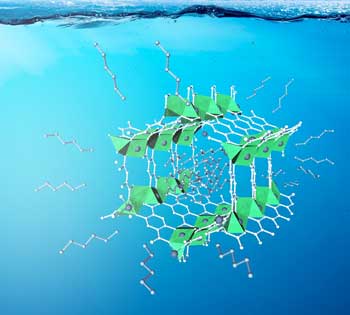 Approach represents a powerful tool for designing selective catalytic heterogeneous processes.
Tuesday, February 25, 2020
When bonding noble metals to 2D materials, interfaces matter
 Researchers have developed new materials for improved single-atom catalysis and future electronics.
Production of high yield Si-C for anodes in Li batteries
 Novel composite combining the high energy storage capacity of silicon and the elastic property of carbon.
Safe method of adding metal particles to organic nanomaterials paves way for better batteries
 Novel liquid-based method for safe synthesis of carbon-based materials containing ultrafine metallic atoms.
Breaking the temperature barrier in small-scale materials testing
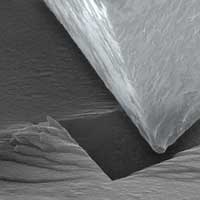 Researchers have demonstrated a new method for testing microscopic aeronautical materials at ultra-high temperatures. By combining electron microscopy and laser heating, scientists can evaluate these materials much more quickly and inexpensively than with traditional testing.
Subscribe to:
Posts (Atom)