 Researchers have developed a novel formulation that describes how heat spreads within crystalline materials. Their equations will make it easier to design next-generation electronic devices at the nanoscale, in which these phenomena can become prevalent.

Tuesday, February 11, 2020
A novel formulation to explain heat propagation
Researchers have developed a novel formulation that describes how heat spreads within crystalline materials. Their equations will make it easier to design next-generation electronic devices at the nanoscale, in which these phenomena can become prevalent.

The shape of water: what water molecules look like on the surface of graphene
 Scientists combine data analysis techniques with molecular dynamics simulations to understand the structure of water on material surfaces.
Harnessing the domino effect for metamaterials
 Researchers use models and experiments to guide and harness transition waves in multi-stable mechanical structures.
Physicists proposed fast method for printing nanolasers from perovskites
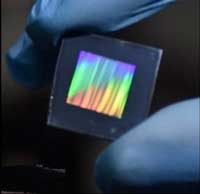 An international research team has developed a new method of synthesizing miniature light sources. It is based on a special laser which produces millions of nanolasers from a perovskite film in a few minutes.
Monday, February 10, 2020
Atom or noise? New method helps cryo-EM researchers tell the difference
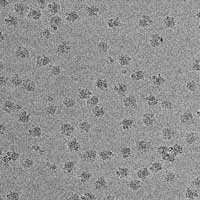 Cryogenic electron microscopy can in principle make out individual atoms in a molecule, but distinguishing the crisp from the blurry parts of an image can be a challenge. A new mathematical method may help.
The human brain's meticulous interface with the bloodstream now on a precision chip
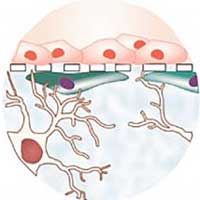 This new human blood-brain barrier on a chip gets its surprising edge by giving astrocytes 3D living space.
Smallest all-digital circuit opens doors to 5 nm next-gen semiconductor
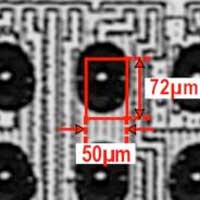 Scientists have designed the world's smallest all-digital phase-locked loop (PLL). PLLs are critical clocking circuits in virtually all digital applications, and reducing their size and improving their performance is a necessary step to enabling the development of next-generation technologies.
Subscribe to:
Posts (Atom)