 Superconductors are regarded as promising components for quantum computers, but so far they only function at very low temperatures. Scientists now demonstrated a so-called energy quantization in nanowires of high-temperature superconductors.

Monday, February 10, 2020
Physicists gain new insights into superconducting processes in nanostructures
Superconductors are regarded as promising components for quantum computers, but so far they only function at very low temperatures. Scientists now demonstrated a so-called energy quantization in nanowires of high-temperature superconductors.

Scientists found a way to treat cancer with iron oxide nanoparticles
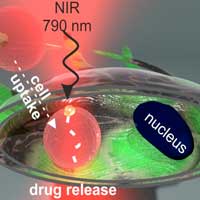 Scientists non-invasively released antitumor drug from polymer containers modified with iron oxide nanoparticles inside primary cancer cells.
DNA-like material could bring even smaller transistors
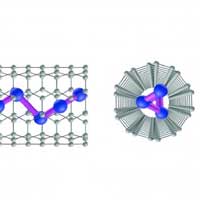 A material shaped like a one-dimensional DNA helix might further push the limits on a transistor's size. The material comes from a rare earth element called tellurium.
A thermometer can be stretched and crumpled by water
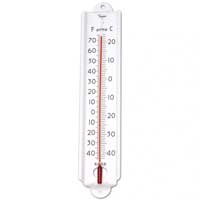 Researchers have developed a flexible ionic conductor that is water-processable and thermal stable.
Researchers virtually 'unwind' lithium battery for the first time
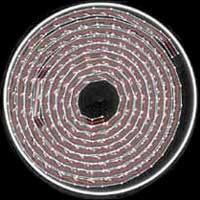 An international team of researchers has revealed new insights into the workings of a lithium battery by virtually 'unrolling' its coil of electrode layers using an algorithm designed for papyrus scrolls.
Friday, February 7, 2020
Physicists trap light in nanoresonators for record time
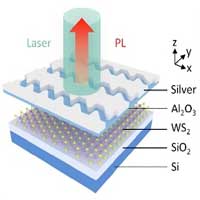 The reference particle captured light for a time exceeding 200 periods of one wave oscillation, 20-40 times longer than usual. This opens new perspectives in such areas as manufacturing compact sensors, night vision devices, and optical data transmission.
Magnetic microrobots use capillary forces to coax particles into position
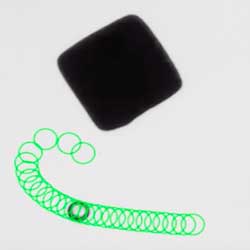 New research shows how simple, microscopic robots, remotely driven by magnetic fields, can use capillary forces to manipulate objects floating at an oil-water interface.
Subscribe to:
Posts (Atom)