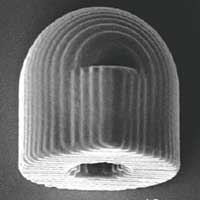
 Researchers have designed and fabricated an untethered microrobot that can slip along either a flat or curved surface in a liquid when exposed to ultrasound waves. Its propulsion force is two to three orders of magnitude stronger than the propulsion force of natural microorganisms such as bacteria or algae.

Tuesday, February 4, 2020
Acoustically driven microrobot outshines natural microswimmers
Researchers have designed and fabricated an untethered microrobot that can slip along either a flat or curved surface in a liquid when exposed to ultrasound waves. Its propulsion force is two to three orders of magnitude stronger than the propulsion force of natural microorganisms such as bacteria or algae.

Finding the source of chemical reactions
 Scientists have demonstrated a way to experimentally detect the most hidden aspect of all chemical reactions - the extremely short-lived transition state that occurs at their initiation. This pivotal discovery could become instrumental in gaining the ability to predict and externally control the outcomes of chemical processes.
Monday, February 3, 2020
New quantum switch turns metals into insulators
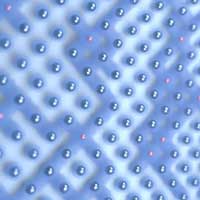 Researchers have demonstrated an entirely new way to precisely control electrical currents by leveraging the interaction between an electron's spin and its orbital rotation around the nucleus.
Scientists discover new non-sticky gels
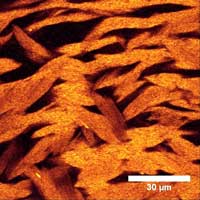 Researchers show that networks and from and persist without the particles sticking to one another if the particles behave as liquid crystals.
Accelerating chemical reactions without direct contact with a catalyst
 Findings expand understanding of catalyst-intermediary-reaction relationship.
New graphene amplifier unlocks hidden frequencies in the electromagnetic spectrum
 Researchers have created a unique device which will unlock the elusive terahertz wavelengths and make revolutionary new technologies possible.
Autonomous microtrap for pathogens
 Self-propelled onion-like microvehicle can attract, trap, and destroy biological threats.
Subscribe to:
Posts (Atom)