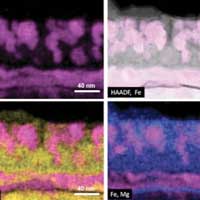
 Scientists used heat to drive a spontaneous process in which different metals mixed to form 3-D interlocking nanostructures in thin films, with applications for catalysts, solar cells, and biomedical sensors.

Wednesday, November 20, 2019
Turning up the heat to create new nanostructured metals
Scientists used heat to drive a spontaneous process in which different metals mixed to form 3-D interlocking nanostructures in thin films, with applications for catalysts, solar cells, and biomedical sensors.

4D imaging with liquid crystal microlenses
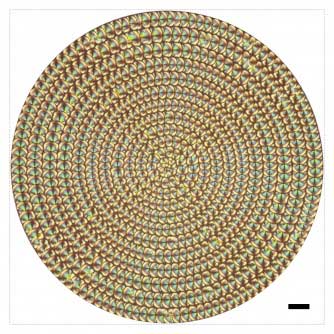 Researchers have developed self-assembling liquid crystal microlenses that can reveal 4D information in one snapshot.
Making tiny antennas for wearable electronics
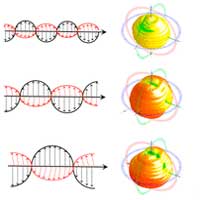 Researchers have made the tiniest radio-frequency antennas reported yet, with thicknesses of about 1/100 of a human hair.
The first high-speed straight motion of magnetic skyrmion at room temperature demonstrated
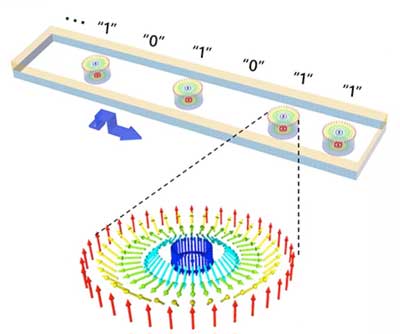 Researchers have, for the first time, successfully demonstrated a formation and current-induced motion of synthetic antiferromagnetic magnetic skyrmions. The established findings are expected to pave the way towards new functional information processing and storage technologies.
New water-based optical device revolutionizes the field of optics research
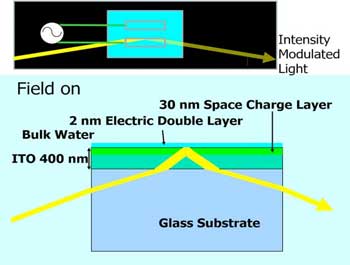 A new method of modulating light using water as a medium, called giant optical modulation, which is less expensive and easier to use than conventional methods.
Tuesday, November 19, 2019
Nanotubes to equip ceramic coatings with heat radiation control
 Researchers have engineered ceramic nanotubes that behave as thermal antennas, offering control over the spectrum and direction of high-temperature heat radiation.
Clean carbon nanotubes with superb properties
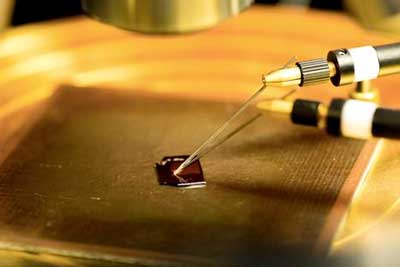 Scientists have found a new way to make ultra-clean carbon nanotube transistors with superior semiconducting properties.
Subscribe to:
Posts (Atom)