 New breakthrough could lead to microfluidic devices that are more portable, scalable.

Wednesday, October 23, 2019
Pre-programmed microfluidic systems offer new control capabilities
New breakthrough could lead to microfluidic devices that are more portable, scalable.

Scientists close to integrating silicon electronics and spintronics
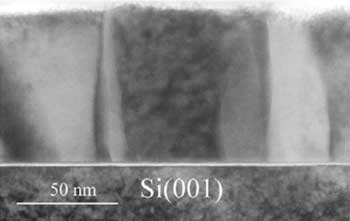 Researchers have developed nanoheterostructures, which can be used as a source of spin-polarized electrons for the semiconductor silicon substrate.
Rethinking the science of plastic recycling
 New catalytic method with nanoparticles could mitigate global plastic pollution.
Flexible, transparent and cost-effective lasers
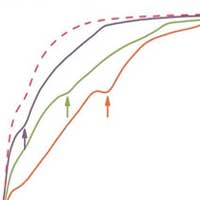 Researchers have produced novel transparent, all-polymer DBF lasers. The DBF lasers make use of the periodic wavelength-scale nanostructures to backscatter photons for constructive interference.
Excitons will shape the future of electronic devices
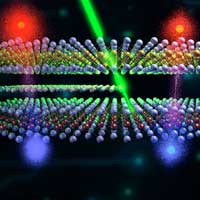 It's a whole new way of thinking about electronics. Excitons - or quasiparticles formed when electrons absorb light - stand to revolutionize the building blocks of circuits. Scientists have been studying their extraordinary properties in order to design more energy-efficient electronic systems, and have now found a way to better control excitons moving in semiconductors.
Tuesday, October 22, 2019
Revealing the nanostructure of wood could help raise height limits for wooden skyscrapers
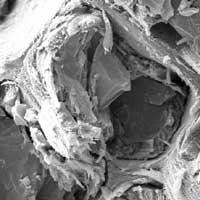 Researchers have captured the visible nanostructure of living wood for the first time using an advanced low-temperature scanning electron microscope.
Magnetics with a twist: Scientists find new way to image spins
 Researchers have put a new spin on measuring and controlling spins in nickel oxide, with an eye toward improving electronic devices? speed and memory capacity.
Subscribe to:
Posts (Atom)