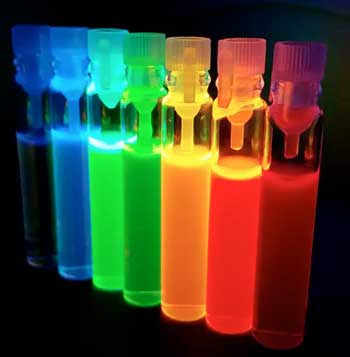
 While many people love colorful photos of landscapes, flowers or rainbows, some biomedical researchers treasure vivid images on a much smaller scale - as tiny as one-thousandth the width of a human hair.

Tuesday, October 15, 2019
Quantum dots that light up TVs could be used for brain research
While many people love colorful photos of landscapes, flowers or rainbows, some biomedical researchers treasure vivid images on a much smaller scale - as tiny as one-thousandth the width of a human hair.

Chains of atoms move at lightning speed inside metals
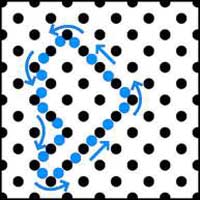 A phenomenon that has previously been seen when researchers simulate the properties of planet cores at extreme pressures has now also been observed in pure titanium at atmospheric pressure. Chains of atoms dash around at lightning speeds inside the solid material.
Metal-organic framework based technology instantly identifies airborne chemicals
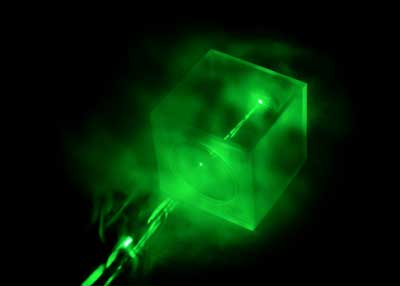 The new prototype device is portable and suitable for rapid deployment by agencies to identify airborne hazards, such as from tiny gas molecules like sulphur dioxide. It can also identify larger compound molecules such as benzene, known to be harmful to human health.
Monday, October 14, 2019
Scientists pinpoint cause of harmful dendrites and whiskers in lithium batteries
 Scientists have uncovered a root cause of the growth of needle-like structures -- known as dendrites and whiskers -- that plague lithium batteries, sometimes causing a short circuit, failure, or even a fire. Such defects are a major factor holding back the batteries from even more widespread use and further improvement.
Unique sticky particles formed by harnessing chaos
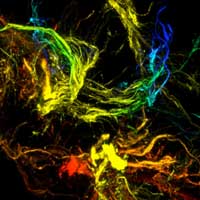 New research shows that unique materials with distinct properties akin to those of gecko feet can be created by harnessing liquid-driven chaos to produce soft polymer microparticles with hierarchical branching on the micro- and nanoscale.
Overlap allows nanoparticles to enhance light-based detection
 Scientists have found revealing information where light from a molecule meets light from a nanoparticle.
How to control friction in topological insulators
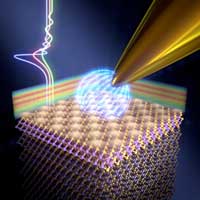 Physicists have begun investigating how topological insulators react to friction. Their experiment shows that the heat generated through friction is significantly lower than in conventional materials.
Subscribe to:
Posts (Atom)