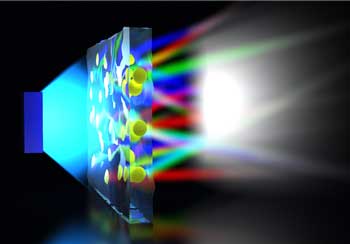
 Scientists introduce a radically new design principle that is based on an analytical model instead of a numerical approach. The model predicts a white LED's color point for any combination of design parameters and allows for a much faster design, by up to a 1 000 000 times, resulting in reduced design and production costs.

Wednesday, October 9, 2019
How to quickly design a white LED?
Scientists introduce a radically new design principle that is based on an analytical model instead of a numerical approach. The model predicts a white LED's color point for any combination of design parameters and allows for a much faster design, by up to a 1 000 000 times, resulting in reduced design and production costs.

Travelling light with the first environmentally friendly graphene smart-case
 A prototype for a graphene-based smart suitcase made of 100% of recycled plastic has been developed.
How to make biocatalysts immortal with dendrimers
 Oxygen threatens sustainable catalysts that use hydrogen to produce electricity in fuel cells. Researchers have developed a way to combat this.
Photocatalytic hydrogen production from water
 Chemists have developed carbon-conjugated covalent organic frameworks for visible light-driven catalytic production of hydrogen gas from water.
Tuesday, October 8, 2019
Location, Location, Location - How charge placement can control a self-assembled structure
 Researchers have achieved precise and predictable control of molecular chains by positioning charges. Their method leads to particles with reproducible sizes.
New optical system can measure flowing liquids as small as 10 nanoliters per minute
 Researchers have developed an optical system that accurately measures the flow of extraordinarily tiny amounts of liquids - as small as 10 billionths of a liter (nanoliters) per minute.
Cooling nanotube resonators with electrons
 Scientists report on a technique that uses electron transport to cool a nanomechanical resonator near the quantum regime.
Subscribe to:
Posts (Atom)