 Scientists are blurring the distinction between brain and machine, designing nanoelectronics that look, move, and feel like real neurons. Camouflaged in the brain, this technology could offer a better way to treat Alzheimer's disease or post-traumatic stress disorder, control prosthetics, or even enhance cognitive abilities.

Thursday, September 5, 2019
The future of mind control
Scientists are blurring the distinction between brain and machine, designing nanoelectronics that look, move, and feel like real neurons. Camouflaged in the brain, this technology could offer a better way to treat Alzheimer's disease or post-traumatic stress disorder, control prosthetics, or even enhance cognitive abilities.

Scientists develop optical ruler that can measure down to the nanoscale
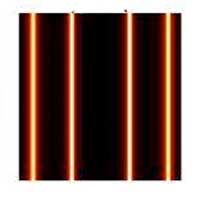 Their achievement was accomplished using a 100-nanometre thick gold film with over 10,000 tiny slits cut into it to diffract laser light and to exploit an optical phenomenon known as superoscillation.
Wednesday, September 4, 2019
Seeking moments of disorder
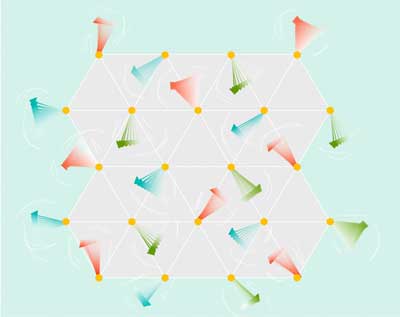 Scientists discover a new, long-hypothesized material state with a signature of quantum disordered liquid-like magnetic moments.
Artificial intelligence helps to predict hybrid nanoparticle structures
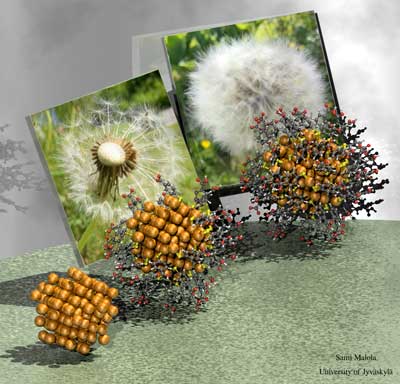 New research demonstrates a new algorithm that 'learns' to predict binding sites of molecules at the metal-molecule interface of hybrid nanoparticles by using already published experimental structural information on nanoparticle reference systems.
Coating nuclear materials with atomic layer deposition
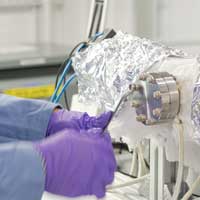 Scientists have discovered a new way to coat nuclear materials that supports efforts to minimize use of high-enriched uranium.
New insulation technique paves the way for more powerful and smaller chips
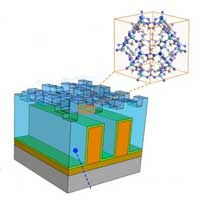 The technique uses metal-organic frameworks, a new type of materials consisting of structured nanopores. In the long term, this method can be used for the development of even smaller and more powerful chips that consume less energy
A novel recipe for efficiently removing intrinsic defects from hard crystals
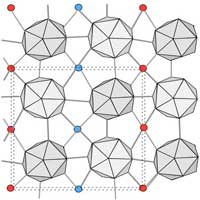 Researchers obtained an ordered phase of boron by adding hydrogen (hydrogenation) at high temperatures and through dehydrogenation by low-temperature annealing.
Subscribe to:
Posts (Atom)