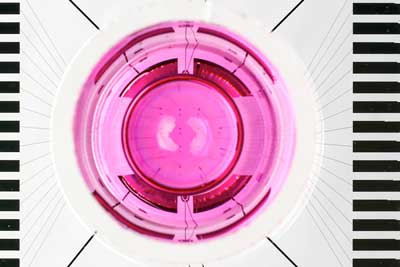
 Researchers have developed a groundbreaking method for studying the electrical signals of cardiac muscle cells. The technology has numerous potential applications in basic and applied research - such as improving the search for mechanisms underlying cardiac arrhythmias.

Wednesday, September 4, 2019
Studying heart cells with nanovolcanoes
Researchers have developed a groundbreaking method for studying the electrical signals of cardiac muscle cells. The technology has numerous potential applications in basic and applied research - such as improving the search for mechanisms underlying cardiac arrhythmias.

Secret messages hidden in light-sensitive polymers
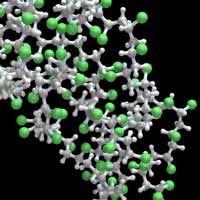 Scientists have shown how valuable light-sensitive macromolecules are: when exposed to the right wavelength of light, they can be transformed so as to change, erase or decode the molecular message that they contain.
'Resonance' Raman spectroscopy with 1-nm resolution
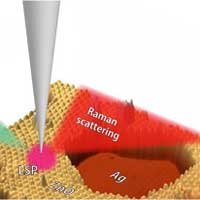 Tip-enhanced Raman spectroscopy resolved 'resonance' Raman scattering with 1-nm resolution in ultrathin zinc oxide films epitaxially grown on a single-crystal silver surface.
Study reveals 'radical' wrinkle in forming complex carbon molecules in space
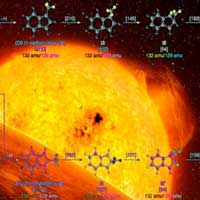 A team of scientists has discovered a new possible pathway toward forming carbon structures in space using a specialized chemical exploration technique.
Tuesday, September 3, 2019
Affordable multiferroic material
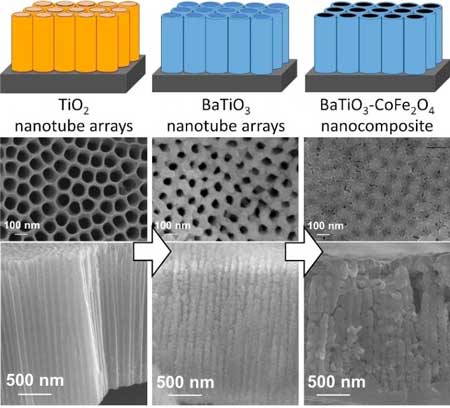 Researchers have developed a novel liquid process for fabrication of an affordable multiferroic nanocomposite film. The multiferroic material obtained by the novel process possesses strong correlation between the electric and the magnetic properties, thus various applications such as low-power-consumption large-volume memory, spatial light modulator, and unique sensors, etc. are expected in the future.
Graphene layer enables advance in super-resolution microscopy
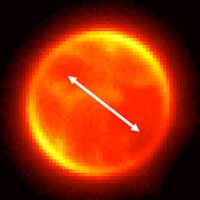 Researchers developed a new method that uses the unusual properties of graphene to interact with fluorescing molecules. This method allows scientists to optically measure extremely small distances, in the order of 1 Angstrom with high accuracy for the first time.
At the edge of chaos, powerful new electronics could be created
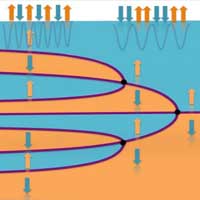 Study shows how ferroic materials could be used to create adaptable neuromorphic electronics.
Subscribe to:
Posts (Atom)