

Thursday, May 3, 2018
Cell membrane inspires new ultrathin electronic film
Researchers have developed a new method to build large areas of semiconductive material that is just two molecules thick and a total of 4.4 nanometers tall. The films function as thin film transistors, and have potential future applications in flexible electronics or chemical detectors.

Chemists develop MRI-like technique to detect what ails batteries
A team of chemists has developed an MRI-based technique that can quickly diagnose what ails certain types of batteries--from determining how much charge remains to detecting internal defects--without opening them up.

Custom silicon microparticles dynamically reconfigure on demand
First demonstration of self-assembling and self-disassembling silicon microparticles could form the basis for designing artificial muscles and reconfigurable computer systems.

Controlling the crystal structure of gallium oxide
Precise control of the atomic structure of gallium-oxide layers improves the development of high-power electronic devices.
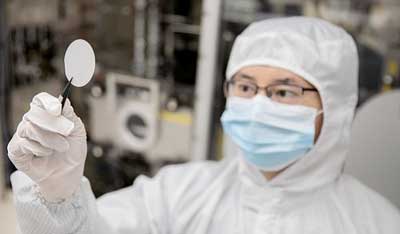
Ultrafast atomic snapshots reveal energy flow in superconductor
Scientists have measured the intricate interactions between atomic nuclei and electrons that are key to understanding intriguing materials properties, such as high-temperature superconductivity.

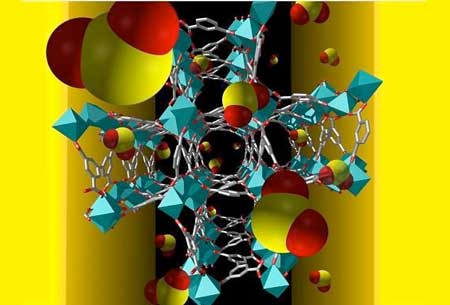
Lining MOF pockets to detect noxious gases
Custom-made gas-sensing material could lead to inexpensive devices for real-time air quality analysis.
Topological domain walls in helimagnets
Three distinct variants of magnetic domain walls have been discovered in the helimagnet iron germanium (FeGe).

Subscribe to:
Posts (Atom)