
Monday, February 12, 2018
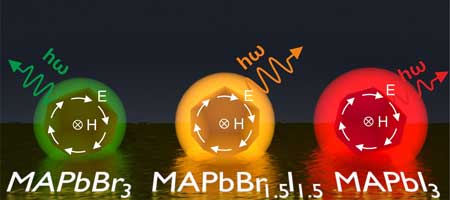
Researchers invented light-emitting nanoantennas based on halide perovskites
Researchers have managed to combine a nanoantenna and a light source in a single nanoparticle. It can generate, enhance and route emission via excited resonant modes coupled with excitons.

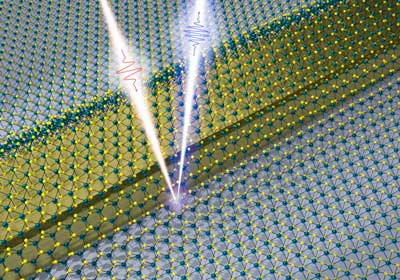
Rubber blanket at an atomic level
Scientists have successfully measured the distortions in 2D materials at microscopic level, which means it is now possible to observe precisely (point for point) how the properties of a material may be altered as a result of a simple distortion.
Friday, February 9, 2018
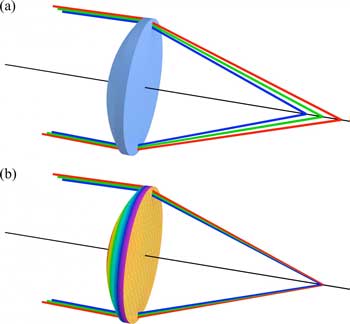
Metasurfaces enable improved optical lens performance
Producing the perfect color images we need and love often requires multiple, heavy lenses so that each color focuses in exactly the same plane. Now engineers have developed a new theory that solves the problem using a single thin lens comprised of gradient index materials and metasurface layers to properly direct the light.
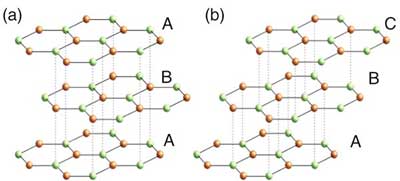
Stacking on the graphene
Researchers have fabricated two types of trilayer graphene with different electrical properties.
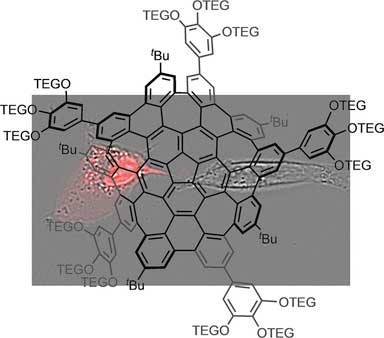
Water-soluble warped nanographene and its application for photo-induced cell death
Researchers have introduced 'warped nanographene', which is soluble in a broad range of solvents while maintaining its photophysical properties.
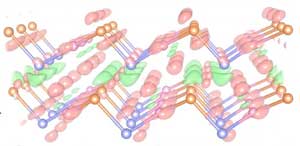
Few-layer tellurium as a promising successor of black phosphorus
Scientists have theoretically predicted few-layer alpha-Tellurium to be a promising elementary semiconductor with extremely high carrier mobility, layer-tunable bandgap, strong light absorption, large strength and good environmental stability.
A super resolution view of chemical reactions
Researchers have demonstrated, using a super resolution microscopic technique, how to follow chemical reactions taking place in very small volumes. The method of analysis is the first to make it potentially possible to observe reactions not only inside living cells, but even within individual organelles, such as cell nuclei.
Subscribe to:
Posts (Atom)