
Saturday, October 24, 2015
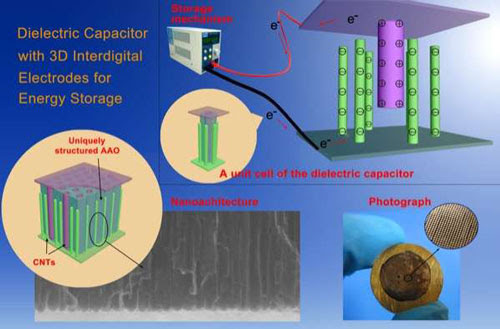
Nanotechnology offers new approach to increasing storage ability of dielectric capacitors
With their new approach, researchers achieved an energy density of about two watts per kilogram, which is significantly higher than that of other dielectric capacitor structures reported in the literature.

Friday, October 23, 2015
Sensing small molecules may revolutionize drug design
Scientists describe a new method for examining small molecules and their communication with membrane proteins. The research will allow scientists and clinicians to study these interactions at an astonishingly minute scale with unprecedented precision.

Photons open the gateway for quantum networks
Quantum technology based on photons, called quantum photonics, will be able to hold much more information than current computer technology. But in order to create a network with photons, you need a photon contact, a kind of transistor that can control the transport of photons in a circuit. Researchers now have managed to create such a contact.

Enzymatic micromotor-driven CO2 sequestration in water
CO2 capture and mineralization in seawater by enzymatic conversion into carbonate with the help of a self-propelled microengine.

Halloysite: Finally a promising natural nanomaterial?
Researchers have recently presented a broad overview of halloysite clay tubes.

Manipulating wrinkles could lead to graphene semiconductors
Scientists have used the tip of a scanning tunneling microscope to manipulate the formation of wrinkles in graphene, opening the way to the construction of graphene semiconductors not through chemical means but by manipulating the carbon structure itself in a form of 'graphene engineering'.
Thursday, October 22, 2015
Researchers transform slow emitters into fast light sources
Researchers have developed a new way to control light from phosphorescent emitters at very high speeds. The technique provides a new approach to modulation that could be useful in all kinds of silicon-based nanoscale devices, including computer chips and other optoelectronic components.

Subscribe to:
Posts (Atom)